
Geometry – space, measurement and data handling (weergawe 3)
Mathematics • Grade 6
Total50 marks
Time60 minutes
Questions27
Name:
Class: Date:
Instructions
- Read all the questions carefully before you begin writing.
- Answer all the questions on the question paper itself.
- Show all your working where the question asks for it.
- Write neatly. Work that cannot be read cannot be marked.
- You may use a pencil and a ruler for drawings.
- Calculators are not allowed.
Sit down with pen and paper. Work through the whole paper before you show the answers — that is how a real test feels.
The answers are right at the bottom of the page.
QUESTION 1 • Multiple choice
[6]
1.1
An angle smaller than 90° is called a ______.
(1)
Answer
a. acute angle
1.2
How many sides does a pentagon have?
(1)
Answer
b. 5
1.3
How many flat faces does a cube have?
(1)
Answer
b. 6
1.4
One kilogram is how many grams?
(1)
Answer
b. 1 000 g
1.5
The area of a rectangle is calculated with:
(1)
Answer
b. length × width
1.6
How many minutes are there in a quarter of an hour?
(1)
Answer
b. 15
QUESTION 2 • Drawing angles
[4]
2.1
Draw an acute angle of 50°. Mark the angle clearly.
(2)
Answer
Any correctly drawn angle of about 50°, with the angle marked.
Marking tip: 1 mark each.
2.2
Draw an obtuse angle of 125°. Mark the angle clearly.
(2)
Answer
Any correctly drawn angle of about 125°, with the angle marked.
Marking tip: 1 mark each.
QUESTION 3 • 2D shapes
[6]
3.1
Name the shapes A to D below.
(4)

Answer
A = rectangle; B = triangle; C = circle; D = pentagon
Marking tip: 1 mark each.
3.2
How many lines of symmetry does a square have?
(1)
Answer
4
3.3
What is the difference between a square and a rectangle?
(1)
Answer
A square has four equal sides; a rectangle has equal opposite sides.
QUESTION 4 • 3D objects
[4]
4.1
Name the 3D objects A, C and E below.
(3)

Answer
A = cube; C = cylinder; E = sphere (ball)
Marking tip: 1 mark each.
4.2
Which 3D object has no flat face?
(1)
Answer
The sphere (ball).
QUESTION 5 • Perimeter, area and volume
[9]
5.1
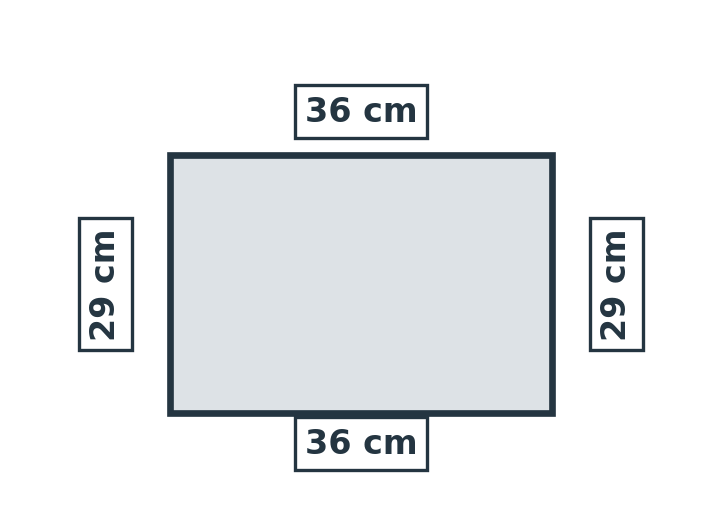
Calculate the PERIMETER and the AREA of the rectangle below.
(4)
Answer
Perimeter = 2(36 + 29) = 130 cm. Area = 36 × 29 = 1 044 cm²
Marking tip: 2 punte elk, met die eenheid.
5.2
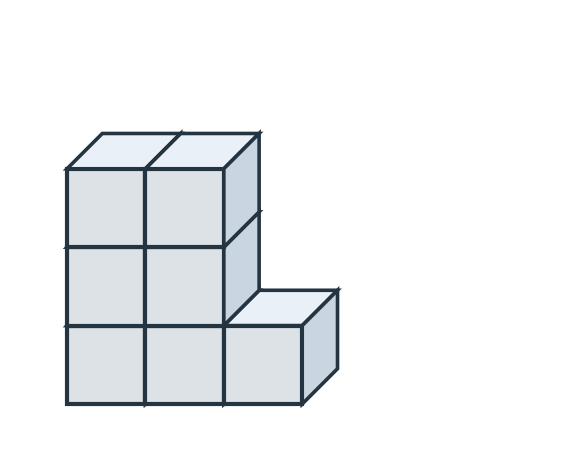
The figure below is built from unit cubes. Determine the volume.
(2)
Answer
7
Marking tip: 1 mark each.
5.3
The perimeter of a square is 36 cm. Calculate the area.
(3)
Answer
36 ÷ 4 = 9; 9 × 9 = 81 cm²
Marking tip: 1 mark per step.
QUESTION 6 • Geometric patterns
[5]
6.1
Draw the 4th figure of the pattern below in the open block.
(1)

Answer
7 blocks in a row.
6.2
How many blocks will Term 5 have? Explain how you know.
(2)
Answer
9 blocks. The pattern adds 2 each time.
Marking tip: 1 mark per step.
6.3
Write down the rule of this pattern.
(2)
Answer
Add 2 each time.
Marking tip: 1 mark per step.
QUESTION 7 • Measurement
[4]
7.1
Convert: 4,2 km = ____________ m
(1)
Answer
4 200 m
7.2
Convert: 2745 g = ____________ kg
(1)
Answer
2,745 kg
7.3
Convert: 7 ℓ = ____________ mℓ
(1)
Answer
7 000 mℓ
7.4
Convert: 48 cm = ____________ mm
(1)
Answer
480 mm
QUESTION 8 • Time
[7]
8.1
Look at the clock below and write down the time.
(3)

Answer
a. quarter past eleven (11:15) b. 23:15
Marking tip: 2 punte vir (a), 1 vir (b).
8.2
A film starts at 13:50 and lasts 40 minutes. What time does it end?
(2)
Answer
13:50 + 40 min = 14:30
Marking tip: 1 mark per step.
8.3
How many days are there from 22 May to 7 June?
(2)
Answer
16
Marking tip: 1 mark per step.
QUESTION 9 • Data handling
[5]
9.1
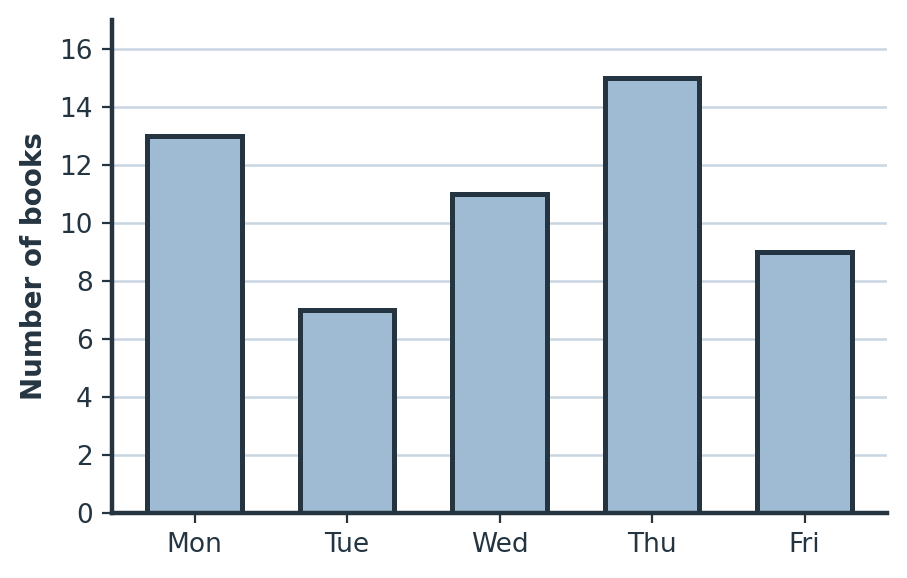
The bar graph shows how many books Grade 6 borrowed each day. Answer the questions.
(5)
Answer
a. 13 + 7 + 11 + 15 + 9 = 55 b. 55 ÷ 5 = 11,0 c. 8 d. Thursday e. 11
Marking tip: 1 mark each.